


Welding or soldering: which joint is right for which job?
Both processes join metal and both have their place. The decision usually comes down to the job in front of you and what the joint has to do. How much load does it have to carry? Will a set stone survive the heat? Will the joint show afterwards? And what does the repair cost in the end?
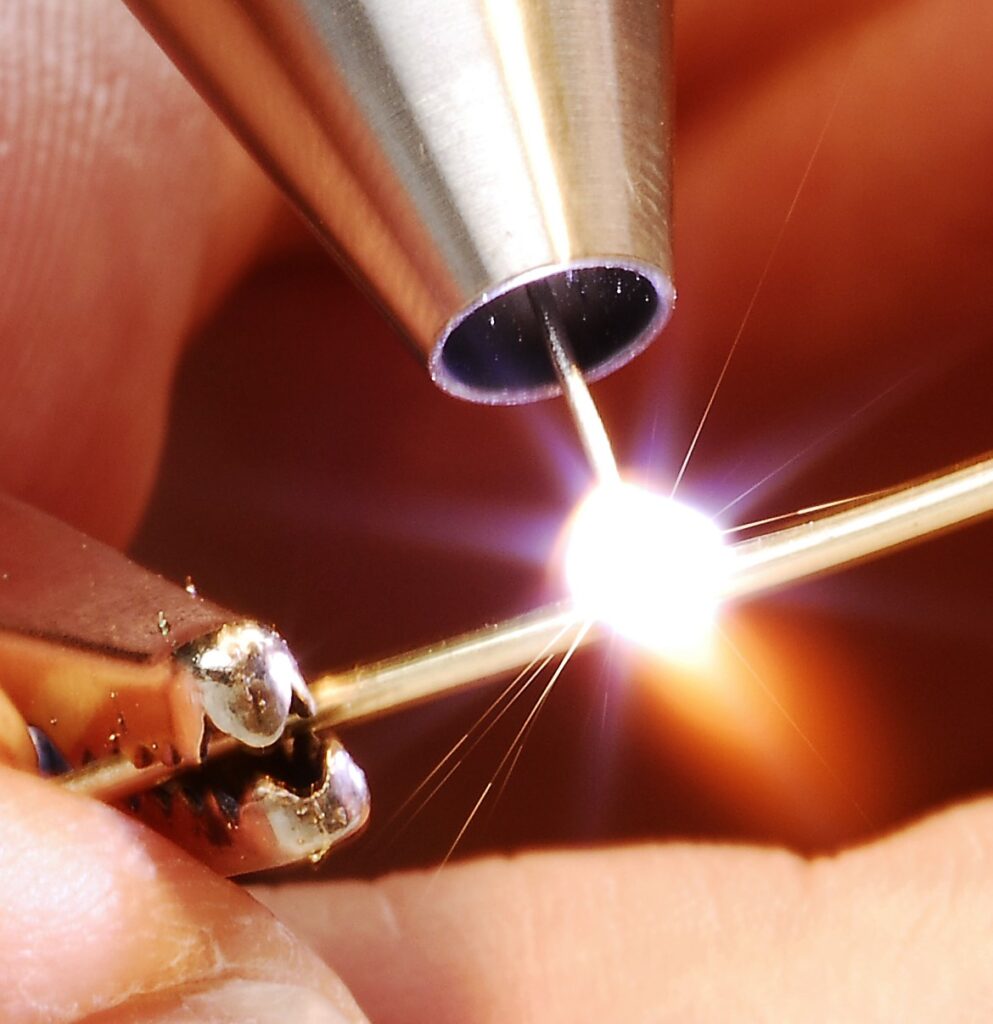
Soldering is compared here with micro-TIG welding, the pulsed precision welding used on material from 0.1 mm upwards in jewelry workshops, dental laboratories and in industry.
In short
- In soldering only the filler melts, in welding the component itself melts. Most of the differences that follow come from this one fact.
- The main practical difference is heat. Soldering warms the entire workpiece, micro-TIG welding warms a spot of 0.2 to 4 millimeters.
- Soldering stays the right choice wherever a gap has to be filled, a surface has to be joined or two dissimilar materials have to be brought together. Capillary joints, long seams, simple electronics (not high-temperature) and furnace brazing are the typical cases.
- Sometimes both are combined, on brass for example. The parts are tack-welded first and soldered afterwards.
Contents of this article
- In short
- What happens during soldering and what happens during welding
- Soldering and micro-TIG welding compared
- Heat: the difference that matters most in daily work
- Strength: what really carries the joint
- Flux, pickling and the workflow
- Appearance, fineness, corrosion and biocompatibility
- Where soldering stays the better choice
- Combining both: tack welding before soldering
- Decision guide by application
- Cost: what each joint really adds up to
- The Lampert machines at a glance
- Frequently asked questions on welding and soldering
- About this article
- Conclusion: when to weld, when to solder
What happens during soldering and what happens during welding
Both are joining processes, but what happens inside the workpiece is fundamentally different. In soldering the base material stays solid and a filler with a lower melting point fills the joint. In welding the base material melts locally, with the micro-TIG process in a short pulse of 0.1 to 34 ms on a spot of 0.2 to 4.0 mm. The heat goes into the material exactly where it is wanted, with or without filler.
Soldering: wetting instead of fusion
In soldering, a filler with a lower melting point than the base material is melted. It wets the faying surfaces, flows into the gap and forms the joint as it solidifies. The parts being joined stay solid. The terminology standard DIN ISO 857-2 draws the line at the liquidus temperature of the filler. Up to 450 degrees Celsius it is soldering, above that it is brazing. The third level once in common use, high-temperature brazing above 900 degrees, comes from the withdrawn DIN 8505 and survives in workshop language. The current standard counts it as brazing.
Welding: the joint comes out of the workpiece itself
In welding, the base material is melted at the joint. The solidified seam is the same material as the component, so the joint matches the parent metal. Either the parent material alone is fused, or welding wire is added to the joint. In micro-TIG welding a short current pulse between a non-consumable tungsten electrode and the workpiece supplies the energy, while argon shields the melt from the surrounding air. Filler is needed only where material has to be built up, and then ideally as a matching welding wire.
Soldering and micro-TIG welding compared
The criteria that separate soldering and micro-TIG welding in daily workshop practice, from the temperature in the component through flux and rework to whether the joint can be taken apart again. The four with the biggest effect on the workflow are covered in detail below. The reference on the welding side is the working range of the Lampert machines, 9 to 630 A on the PUK 6.1 and 5 to 1,200 A on the Micro Arc Welder, each with a pulse duration of 0.1 to 34 ms.
| Criterion | Soldering | Micro-TIG welding |
| Joining mechanism | The filler melts and wets the parts, which stay solid | The base material itself melts and solidifies into a joint that matches the parent metal |
| Temperature in the component | The whole component has to be brought to working temperature | Heat stays local, the component normally stays warm to the touch |
| Filler | Solder, a foreign alloy sitting in the joint | None needed; where material is built up, a matching welding wire |
| Flux | Required, except when soldering under shielding gas or in a vacuum | Not required, argon shields the melt |
| Rework | Pickling, neutralizing, restoring the polish | Largely eliminated |
| Strength | Set by the filler, usually below the base material | Can reach the strength of the base material |
| Appearance | The solder seam has a different color and tarnishes differently | Matches the parent metal, practically invisible after polishing |
| Corrosion | Foreign metal in the joint and the solder gap encourage galvanic and crevice corrosion | No foreign alloy, no designed-in gap |
| Gap bridging | A strength of the process, capillary gaps typically 0.05 to 0.2 mm | Limited, the faying surfaces should be in contact |
| Heat-sensitive parts | Stones, plastics, springs and electronics are at risk | Can normally stay in the component |
| Several joints on one part | Needs solders with stepped melting points, otherwise the previous joint lets go | Usually repeatable as often as needed |
| Taking the joint apart | Soft-soldered joints can be released by heating | Not separable without destroying the joint |
Heat: the difference that matters most in daily work
How heat spreads during soldering
Soldering works through capillary action and wetting, and that requires the whole joint area to reach working temperature. In practice the whole component gets hot. Set stones often have to be taken out of their settings, plastic parts and seals are at risk and can melt, adjacent solder joints let go, and on sterling silver firescale forms across the surface.
What a pulse of a few milliseconds changes
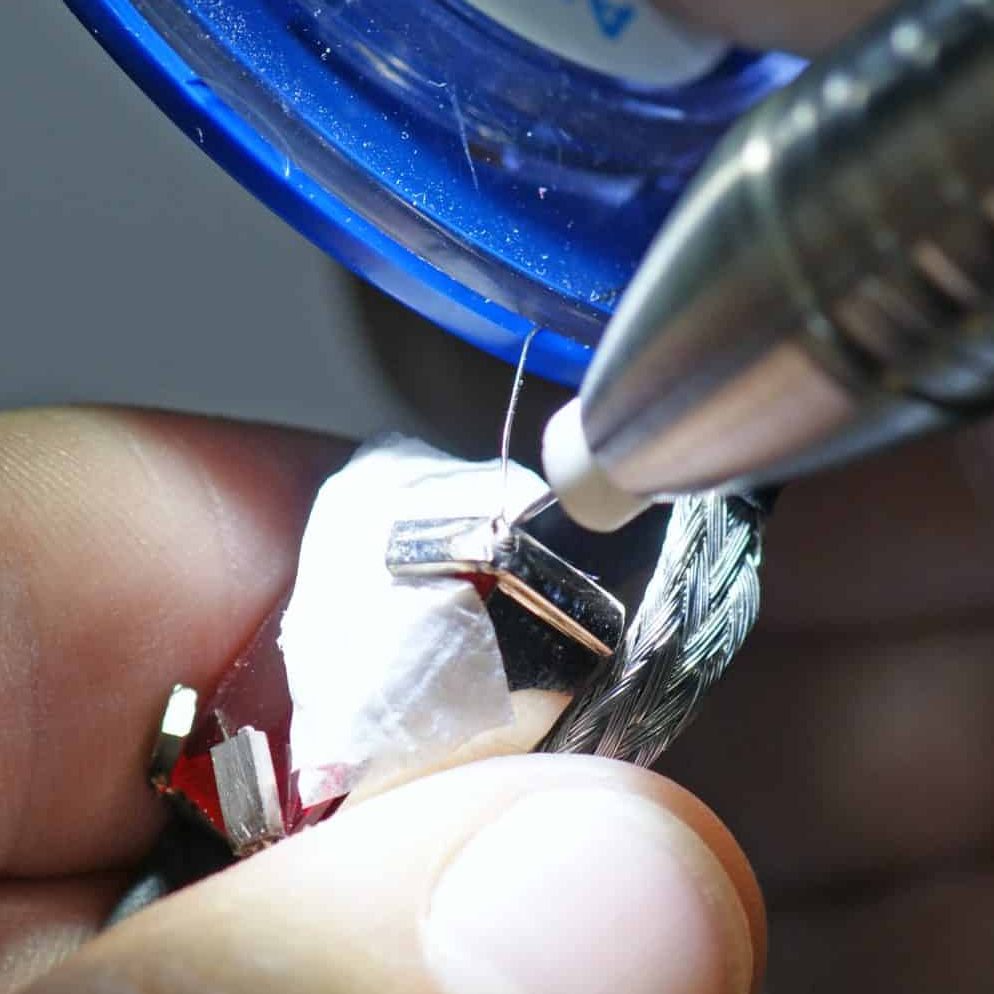
In micro-TIG welding the pulse lasts between 0.1 and 34 ms. In that time the material melts locally and the heat drains straight into the surrounding metal. The component stays warm to the touch and can often be held in the hand while working.
That opens up work which simply cannot be done with a torch.
- Resizing rings while the stone stays set.
- Welding clasps onto finished, polished chains.
- Closing sensors and housings with temperature-sensitive electronics inside.
Practical examples can be found under jewelry and industrial applications.
Strength: what really carries the joint
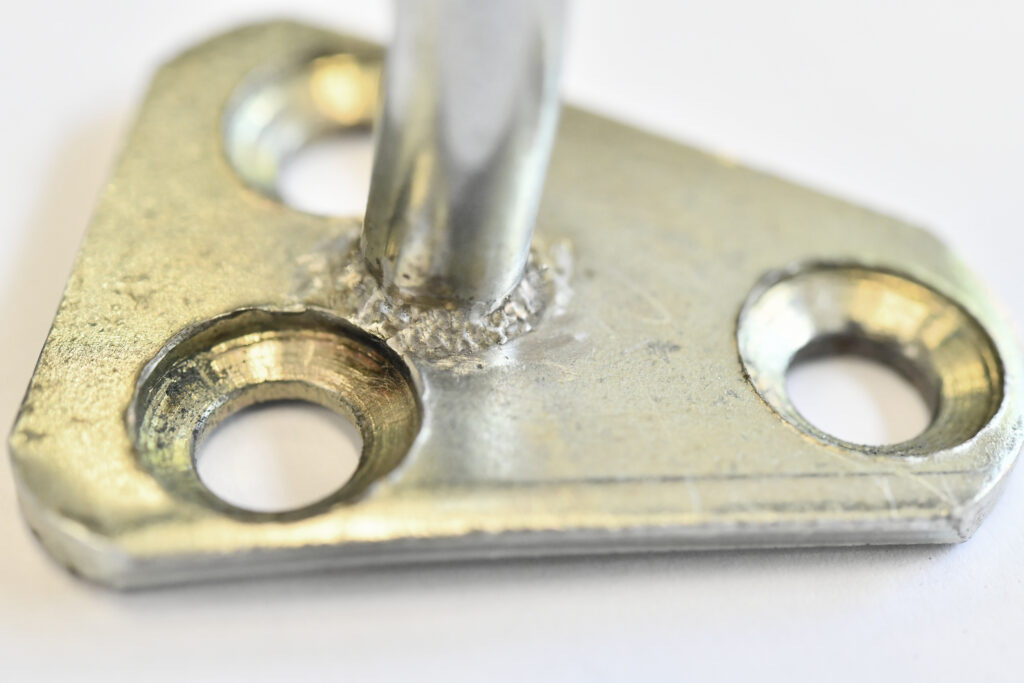
A soldered joint is only as strong as the solder, not as strong as the component. Silver and gold brazing alloys sit below their base materials in strength, soft solders well below. Area makes up for it. A capillary gap of typically 0.05 to 0.2 mm together with a generous overlap gives a joint that carries load even though the solder on its own is softer.
A weld seam, by contrast, is made of the base material itself, often together with a matching wire, and can reach its strength. There is no foreign alloy acting as a weak point and no designed-in gap in the joint.
Flux, pickling and the workflow
Soldering needs flux so the solder wets and the surface stays free of oxide. Afterwards the residues have to come off, normally by pickling and neutralizing, otherwise they corrode. Then the polish is rebuilt. Micro-TIG welding drops that whole chain, because the shielding gas does the job of the flux: argon 4.6 at a purity of 99.996 %.
The argon pushes oxygen out of the weld zone for as long as the spot is hot, at around 2 l/min and with automatic pre-flow and post-flow. No flux means no residues, no pickling, no neutralizing.
The real gain is in the order of the work steps. A piece can be finished completely and set, then welded, then polished. With soldering it runs the other way round: join first, pickle, then rebuild the surface. On repairs to finished pieces that difference is where the time is saved, not in the seconds at the pulse.
If dark spots are left after welding, that points to the gas coverage or to residues on the workpiece. The weld area should therefore always be cleaned beforehand, exactly as it is before soldering.
Appearance, fineness, corrosion and biocompatibility
You either see the seam or you do not
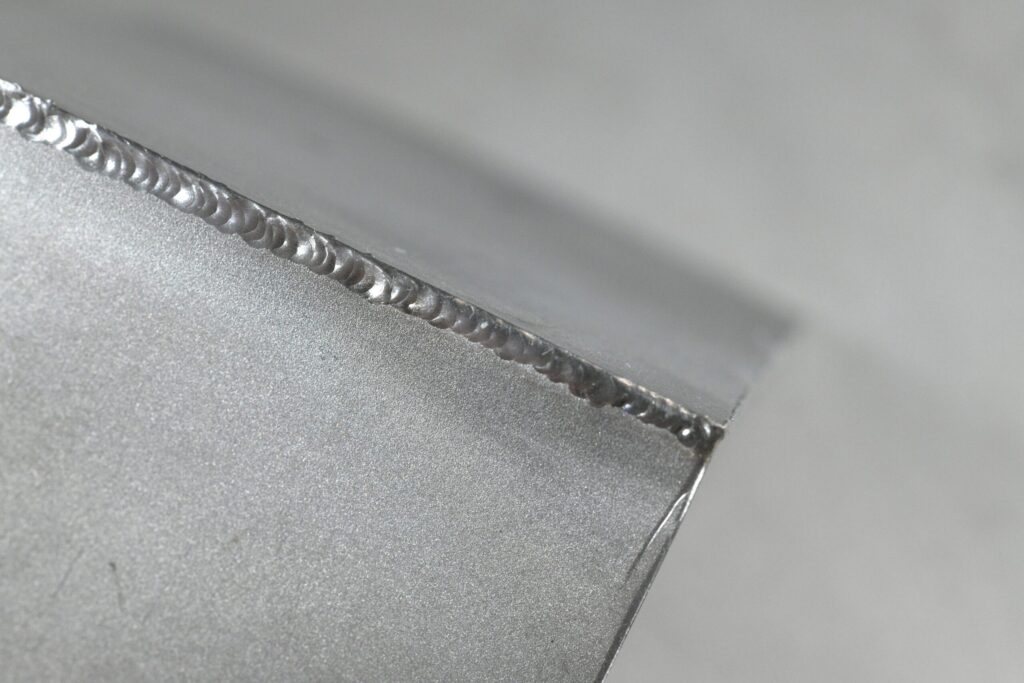
A solder seam is a different alloy from the workpiece. It has a slightly different shade, takes polish differently and tarnishes differently over time than the metal around it. On white gold, rhodium-plated surfaces and strongly colored alloys that shows. A weld seam matches the parent metal and is almost invisible once polished.
Fineness
Solders used in precious metal work have a lower fineness than the workpiece by design. Anyone working to declared fineness and hallmarks has to keep the solder content in view. With a matching weld the question does not arise.
Corrosion and cadmium in older pieces
Two different metals in conductive contact form an electrochemical cell that encourages galvanic corrosion. On top of that comes the solder gap itself, where moisture and residues collect. A matching weld seam has neither foreign metal nor a designed-in gap. Cadmium-bearing brazing alloys have been banned in the EU since 2011 under Annex XVII entry 23 of the REACH regulation, from 0.01 % cadmium in the filler. They can still be sitting in repair pieces placed on the market before 10 December 2011.
Dental and medical technology
This is exactly why precision welding took hold in dental technology and orthodontics. Solder gaps in the oral environment are a weak point, both for corrosion and as a niche for deposits, and every additional foreign metal is one more factor in the material assessment. Application examples can be found under orthodontics and dental technology.
Where soldering stays the better choice
A precision welding machine does not replace the soldering bench completely. Wherever a gap is wanted by design, wherever a large area has to be joined in one operation, or wherever two very different metals come together, soldering remains the right process. The capillary gaps a soldered design is built around are typically 0.05 to 0.2 mm, while welding requires the faying surfaces to be in contact.
- The gap as a design principle: on tube-in-socket, bush and plug-in connections the solder flows in and bonds over a large area.
- Large areas: anything to be joined across a surface takes one operation in soldering and spot after spot in precision welding.
- Imprecise fit: if the parts do not sit cleanly against each other, solder can fill the gap. Welding needs the surfaces in contact.
- Very different materials: for pairings that form brittle intermetallic phases when melted, soldering is the metallurgically safe route.
- Electronics: solder joints are electrically defined, thermally gentle and reversible. On printed circuit boards soldering is the standard.
- Series production: furnace and induction brazing join many points at once and reproducibly through controlled temperature.
- Joints that have to come apart: soft-soldered joints can be separated again by heating, a weld seam cannot.
Combining both: tack welding before soldering
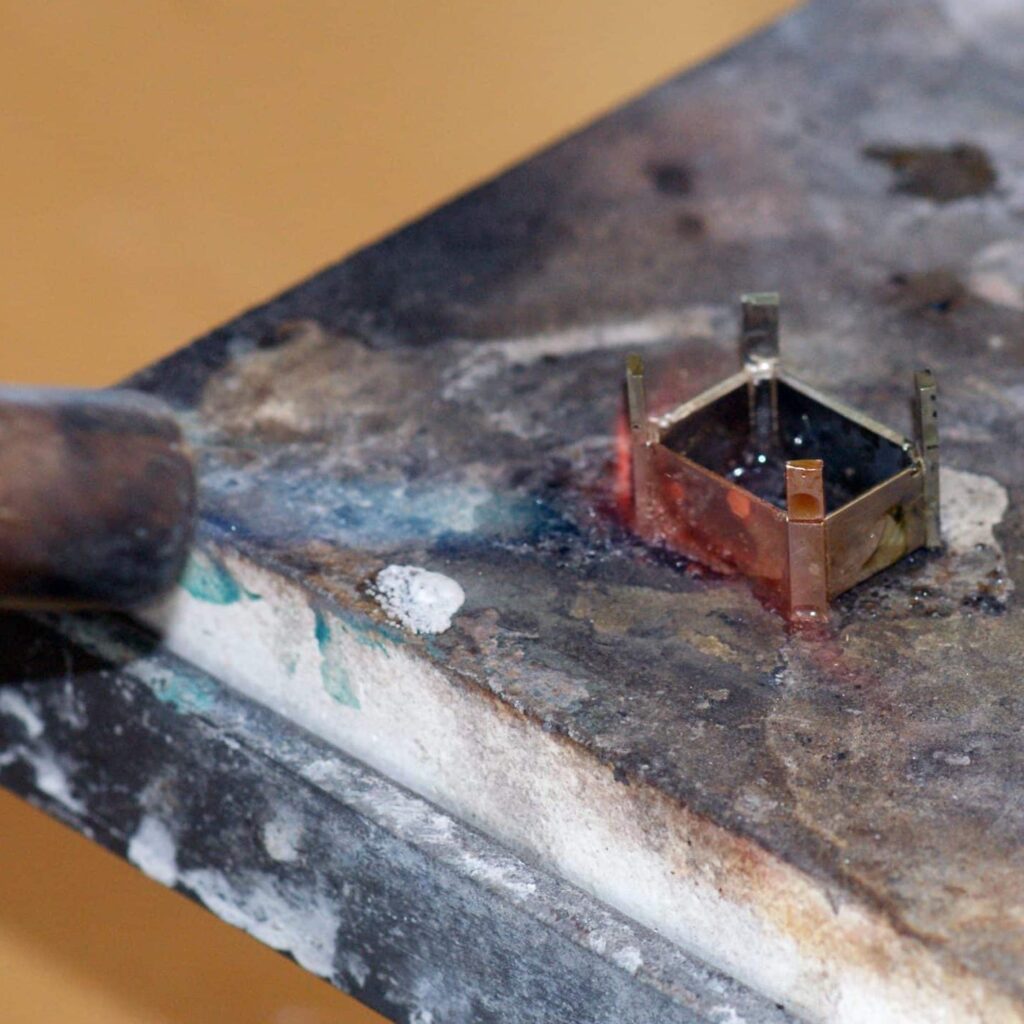
The two processes do not rule each other out, they work together. The most common combination is tack welding: the parts are tacked in exactly the right position with short, high-energy pulses and then soldered conventionally. That replaces binding wire, clamps and holding compound, the parts can no longer shift while heating, and the fit is right at the end.
The PUK has a dedicated tack-weld mode for this, 80 to 700 A at 1.5 ms, the PUK D a tack-weld connection. Other combinations that work in practice:
- Closing pores and shrinkage cavities in castings with matching material, then carrying on as usual and soldering elsewhere on the piece.
- Removing an old solder joint mechanically and welding the repair with matching material, so the seam matches the workpiece in color and tarnishing.
- Welding the heat-sensitive assembly first, then soldering the uncritical, coarser joint.
Decision guide by application
The short version for daily workshop use, sorted by task rather than by process. Each task carries the recommendation and the reason behind it, so the decision stays traceable and can be carried over to a similar part. In borderline cases a test piece decides, not the table, because from 0.1 mm material thickness both are usually technically possible, and wall thickness, alloy and accessibility then shift the result.
| Task | Recommendation | Reason |
| Resizing a ring with a set stone | Welding | The stone can stay in the piece, no unsetting and resetting |
| Adding prongs and claws | Welding | Material built up on the smallest structures without heating the setting |
| Filling pores and shrinkage cavities in castings | Welding | Matching material applied spot by spot, no solder color in the flaw |
| Orthodontic wires and appliances | Welding | No foreign metal and no solder gap in the oral environment, the wire keeps its properties |
| Repairing surgical instruments | Welding | A matching seam with no gap for residues to collect in |
| Sealing a sensor housing hermetically | Welding | A tight, matching seam that can be verified by leak test |
| Tube in socket, capillary joint | Soldering | The capillary gap is the basis of the design, the solder flows into it |
| Long seam or large area | Soldering | A surface joined in one operation rather than spot by spot |
| Joining very different materials | Soldering | The solder wets both sides without creating brittle mixed phases |
| Electronic components | Soldering | A defined electrical contact, reversible, gentle on the components |
Cost: what each joint really adds up to
The cost comparison hangs less on the purchase than on the rework that follows every joint. Soldering consumes material on every joint: solder, flux, pickle and fuel gas. Precision welding consumes almost only argon at around 2 l/min and the electrode. What decides it is working time, because pickling, neutralizing and re-polishing fall away. Complete setups start at around 4,400 EUR net ex works.
What soldering costs
Per joint: solder, itself a material of value in precious metals, flux, pickle, fuel gas, and above all working time for pickling, neutralizing and re-polishing. On top of that comes the scrap risk on valuable parts when stones, springs or plastics do not survive the heat.
What precision welding costs
The machine itself, then argon at around 2 l/min, electrodes that can be reground several times, and welding wire where material is built up. Consumption per joint is minimal and rework largely disappears.
What the payback depends on
It depends on rework saved, scrap avoided and the jobs that no longer leave the workshop. Working complete setups with eye protection and gas supply start at around 4,400 EUR net ex works for the PUK, 5,100 EUR for the PUK D and 7,000 EUR for the Micro Arc Welder. Leasing is available.
The Lampert machines at a glance
All three professional machines work on the same micro-TIG principle and differ in power, programs and intended use. With 9 to 630 A the PUK covers goldsmiths and silversmiths, the PUK D adds a micro mode below 0.2 mm for orthodontic wires at the same power, and the Micro Arc Welder with 5 to 1,200 A covers industry, laboratory and repair. Anyone who wants to try a machine on site will find the nearest contact under where to buy.
| Feature | Micro Arc Welder | PUK | PUK D |
| Field of use | Industry, laboratory, research, repair | Goldsmiths, silversmiths, jewelers, watchmakers | Dental technology, dental laboratory, orthodontics |
| Peak current (TIG) | 5 to 1,200 A | 9 to 630 A | 9 to 630 A |
| Pulse duration | 0.1 to 34 ms | 0.1 to 34 ms | 0.1 to 34 ms |
| Minimum workpiece thickness | from 0.1 mm | from 0.1 mm | micro mode below 0.2 mm for orthodontic wires |
| Tacking before soldering | through short pulses | dedicated tack-weld mode, 80 to 700 A at 1.5 ms | tack-weld connection |
| Material programs | 12 (universal, gold, silver, platinum, palladium, bronze, stainless steel, titanium, aluminum, tin, brass, copper) | 11 | 10 dental alloys |
| Shielding gas | Argon 4.6, approx. 2 l/min, automatic pre-flow and post-flow, no flux | ||
| Interface | Modbus TCP/IP over LAN, 21 documented registers | none | none |
| Certification | EN 60974-6, EN 61000-6-2/-6-4, EN 63000 (RoHS), CE and UKCA | ||
| Warranty | 1 year | 3 years | 3 years |
| Investment (complete entry package) | from approx. 7,000 EUR net | from approx. 4,400 EUR net | from approx. 5,100 EUR net |
Frequently asked questions on welding and soldering
In principle yes, because the weld seam is made of the base material itself and can reach its strength, while a soldered joint has the strength of the solder, and that normally sits below. In practice it depends on the execution: a large-area brazed joint with a properly designed gap can carry more than a badly welded seam. The advantage of welding is that the joint matches the parent metal, with no foreign alloy sitting in it as a weak point.
The line sits at 450 degrees Celsius, measured at the liquidus temperature of the filler. Under DIN ISO 857-2 it is soldering when the filler becomes liquid below 450 degrees and brazing above that. Solders are mostly tin-based and give comparatively soft joints, brazing alloys based on silver, brass or gold give much stronger ones. The third level once in common use, high-temperature brazing above 900 degrees, comes from the withdrawn DIN 8505. The current terminology standard knows only the two categories, even though the term lives on in practice.
Yes, and that is one of the main reasons the process is used in jewelry. The pulse lasts only fractions of a millisecond up to a few milliseconds, the heat stays local and the component barely warms up overall. Resizing rings, adding prongs or welding on clasps is possible without unsetting the stone. Soldering would mean bringing the piece up to soldering temperature over a large area, which many stones do not survive.
In most repair and assembly jobs, yes. The gain is twofold: no foreign metal in the joint, so no visible solder seam and no different tarnishing, and no heat across the whole piece, so no stones to unset and less firescale. For capillary joints, gap bridging and large areas, soldering stays the right route.
No. Micro-TIG welding uses no flux, the argon does that job and keeps oxygen away from the melt. For the workflow that means a piece can be finished, set and polished and only then welded. With soldering the surface has to be rebuilt afterwards.
No, that almost always produces pores and inclusions. Soft solders contain tin and sometimes lead, brazing alloys contain zinc, older silver brazing alloys also cadmium. These elements boil far below welding temperature, vaporize suddenly and contaminate the weld pool. The solder residues have to be removed mechanically first, down to bare base material.
No. Under Annex XVII entry 23 of the REACH regulation, extended by Regulation (EU) 494/2011, brazing alloys and metal parts of jewelry with a cadmium content of 0.01 percent by weight or more may no longer be used or placed on the market. Jewelry already on the market before 10 December 2011, or more than 50 years old at that date, is among the exemptions, and it is exactly this older stock that arrives in the repair workshop. Where the origin of an old solder joint is unclear, the solder should be removed mechanically and the workplace extracted properly, because vaporizing it produces toxic cadmium oxide fumes.
Tack welding holds two parts in exactly the right position with short, high-energy pulses before they are soldered conventionally or worked on further. It replaces binding wire, clamps and holding compound and is therefore the most common combination of the two processes. Parameters and further cases are in the section combining both above.
In part. Related materials such as different stainless steels or gold alloys of different fineness normally join well. With very different metals brittle intermetallic phases form, and there soldering is often the better route because the solder wets both materials without melting them. For a specific pairing a sample weld is worth doing before going into series.
Not on the unit price per joint, but on the rework saved, the scrap avoided and the jobs that then stay in house. The individual items are in the section on cost above. Working complete setups start at around 4,400 EUR net ex works for the PUK, and leasing is available.
About this article
This article comes from Lampert Werktechnik, manufacturer of the micro-TIG precision welding machines PUK, PUK D and Micro Arc Welder. The company was founded in 2001 in Werneck in Lower Franconia and has been developing, building and servicing there for more than 20 years. The machines are in use in over 100 countries and the dealer network covers more than 60. The figures in this article come from the operating manuals, the declarations of conformity and daily application support.
A specific question about a part of your own? The application team welds it free of charge and documents the parameters in a written welding report. Send your request through our contact form. Anyone who wants to see a machine on site will find the nearest contact under where to buy.
Conclusion: when to weld, when to solder
Soldering joins through a filler and needs heat in the whole component, flux and rework for it. Precision welding fuses the component itself, spot by spot in 0.1 to 34 ms on a spot of 0.2 to 4.0 mm, without flux and without pickling. Where heat-sensitive parts, a seam that matches the parent metal, freedom from corrosion in the joint or repairs to finished pieces are at stake, welding has the advantage. Where gaps have to be bridged, surfaces joined or dissimilar materials brought together, soldering stays the right process.
Most workshops therefore run both and use tack welding as the bridge between them. Anyone who wants to know how their own part behaves can send material, wall thickness and requirement through our contact form and gets a free sample weld with a written welding report back. Further reading: micro-welding and precision welding at a glance and the glossary.
A question about a specific part?
Our application engineers look at your joining task and answer with solid figures on material, parameters and feasibility. A sample weld with a written welding report is free of charge and possible from 0.1 mm material thickness. The result comes back with the parameters used, so you can reproduce it on your own part.