


Welding platinum capsules: hermetic seals
in the laboratory
Hermetically sealing a platinum capsule means joining a thin-walled precious-metal shell in a gas-tight manner without altering the sample inside. In the laboratory, the actual experiment is often contained within: a mineral sample for high-pressure petrology, a reference standard for trace element analysis, or an air-sensitive substance. Three properties determine the sealing process: seam tightness, minimal heat input to the capsule’s contents, and reproducible seam quality across the batch. Micro-TIG welding with the Lampert Micro Arc Welder (MAW) delivers all three, even for wall thicknesses in the range of tenths of a millimeter.

Why platinum?
In the laboratory, platinum is not jewelry, but a functional material. This is due to two properties that work together: platinum is chemically inert and can withstand high temperatures. It resists mineral acids, air, and water under normal conditions and hardly reacts with the enclosed sample material, even under high pressure and high temperature. Thus, the capsule material does not interfere with the experiment.
The melting point of pure platinum is about 1,768 °C, significantly higher than that of gold (about 1,064 °C) or silver. For welding, this means that platinum requires more energy than the softer precious metals, but remains very weldable. In the Lampert material classification system, platinum is considered very weldable, with a note to use higher settings due to its higher melting point.
Typical laboratory capsules have thin walls, often with a wall thickness of 0.1 to 0.3 mm. This is precisely where the sealing process becomes critical: the seam must be airtight without burning through the wall and without allowing heat to reach the sample. The pulse duration, measured in milliseconds, is the key factor here.
Typical applications
for platinum capsules
Platinum capsules are used where
a sample needs to be enclosed under conditions
that other materials cannot withstand or that would distort the sample:
- High-pressure research capsules:
Platinum and platinum-rhodium capsules for diamond anvil cell experiments and high-pressure experimental petrology.
A platinum shell is welded to a platinum lid, forming a chemically sealed closure before the sample is subjected to pressure. - Reference and standard capsules for isotopic, neutron activation, and trace element analysis (
), in which a standard or sample is hermetically sealed. - Encapsulation in a glovebox atmosphere:
Seal air- or moisture-sensitive substances in platinum capsules under an inert gas atmosphere.
Laboratory applications differ from industrial mass production: the focus is not on output per hour, but on achieving a reproducible, verifiably tight seam on each individual part.
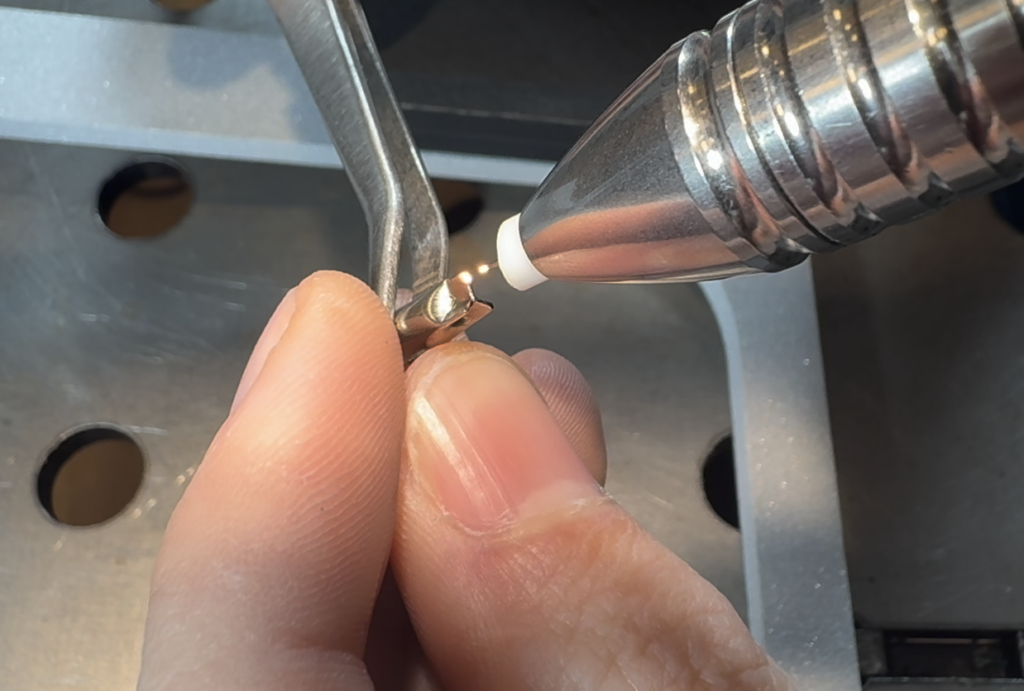
Materials used in the platinum capsules
Platinum is rarely used on its own. In practice, platinum capsules are combined with related precious and functional materials. The overview below shows what can be joined hermetically with the MAW:
| Material | Typical applications | Weldability |
|---|---|---|
| Platinum (Pt) | High-pressure capsules, reference capsules, crucible joints | Very good; higher energy than gold/silver due to melting point |
| Platinum-rhodium (Pt-Rh) | Diamond-stamped cells, Pt/Pt-Rh thermocouples | Very good, thin wall thicknesses |
| Gold / palladium | Softer capsules, lower pressure/temperature levels | Very good, lower energy than platinum |
| Stainless steel 1.4404 / 316L | Sample capsules, sensor and pressure transducer housings | Very good, biocompatible |
| Grade 2 / Grade 5 titanium | Corrosion-critical lab capsules, implantable housings | Very good; very good inert gas coverage required |
| Tantalum / niobium / zirconium | Special-purpose and corrosion-critical encapsulation for laboratory use | Subject to conditions; test welding recommended |
The complete methodology and material classification within the cluster: hermetic sealing with micro-TIG welding.
Why micro-TIG welding for platinum capsules
- Minimal heat input to the capsule contents:
Pulse durations ranging from 0.1 to 34 milliseconds concentrate the heat on the seam.
The capsule wall absorbs the energy; the contents remain unaffected. For air-sensitive substances, mineral samples, and prepared standards, this is the difference between a usable sample and a compromised one. - Energy range for thin walls and higher melting points:
With peak currents ranging from 5 to 1,200 a, MAW covers both the low energy required for 0.1-mm walls and the higher energy that
requires for platinum due to its melting point. - Pure metallurgical bond:
No flux, no solder line, no contamination pathways.
Important for laboratory applications involving isotopic or chemical analysis, where any foreign substance can interfere with the results. - Reproducibility through preinstalled welding curves:
The MAW comes with a dedicated platinum program (part of the twelve preinstalled material programs). Parameters are documented,
and processes are repeatable across batches. - Glovebox-compatible:
With the appropriate preparation, the MAW operates in inert gas atmospheres, providing protection for components sensitive to air or moisture. - Suitable for helium leak testing:
When properly prepared, the seam consistently meets the hermeticity specifications typical for the application.
For high-pressure research capsules, typical acceptance leak rates range between 10⁻⁶ and 10⁻⁸ mbar·l/s.
The “Helium leak test: a practical guide to hermetic welds” discusses how to qualify a weld.
Practical recommendations for welding thin-walled platinum capsules
Preparation
- Thoroughly pre-clean the workpiece:
Ultrasonic cleaning is the laboratory standard.
Contaminants in pores or crevices burn off during welding and cause porosity in the weld. - Check the joint geometry:
A weld seam only seals parts that fit together without any gap.
Proper contact between the lid and the rim of the container is essential for a tight seam. - Add the contents before sealing:
Add the sample first, then seal the capsule.
The minimal heat input ensures process reliability.
Welding parameters
- Low to medium energy plus a ground tungsten electrode for thin capsule walls.
Practical starting point for wall thicknesses of approx. 0.2 mm: 35 to 40 % energy, 6 to 10 ms pulse duration.
Platinum tends to fall at the upper end of this range due to its higher melting point. - Inert gas:
Argon ≥ 99.9% (argon 4.6), optimal flow rate approx. 2 l/min with automatic pre- and post-flow. - For contents that are highly sensitive to heat:
Take measures to dissipate heat from the workpiece or use a clamping device.
Validation
- Visual inspection under a microscope:
Clean, oxide-free weld with no pores.
Platinum oxidizes very little; however, a dull or grainy weld indicates excessive energy or insufficient inert gas. - Helium leak test:
After welding, depending on the geometry and target leak rate.
Determine the target value before designing the weld. - Cross-section of initial samples:
Document penetration depth and seam quality before starting mass production.
Device recommendation: the Lampert Micro Arc Welder
| Specification | Value |
|---|---|
| Peak current (TIG) | 5-1.200 a |
| Pulse duration | 0.1-34 ms |
| Minimum workpiece thickness | 0.1 mm |
| Spot weld diameter | 0.2-4.0 mm; >1 mm penetration with 1.3 mm electrode |
| Material programs (pre-installed) | 12 (universal, gold, silver, platinum, palladium, bronze, stainless steel, titanium, aluminum, tin, brass, copper) |
| Patented welding process control | Yes (real-time fault detection) |
| Industry 4.0 interface | Modbus TCP/IP via LAN (21 documented registers) |
| Inert gas | Argon ≥ 99.9 %; approx. 2 l/min |
| Weight | 10.9 kg |
| EU certification | EN 60974-6, EN 61000-6-2/-6-4, RoHS 2011/65/EU; UKCA-compliant |
| Warranty | 1 year; manufactured and serviced in Germany |
| Investment (complete entry) | from approx. 7,000 EUR net |
Full product specification: Lampert Micro Arc Welder product page.
Frequently asked questions about welding platinum capsules
Yes. Platinum is considered very weldable. Because of its higher melting point of about 1,768 °C, higher temperatures are required than for gold or silver, but the process remains the same. Platinum-rhodium alloys behave similarly.
Using low energy and short pulse durations. Practical starting point for wall thicknesses of 0.1 to 0.3 mm: 15 to 25 % energy, 0.5 to 1.5 ms pulse duration; increase parameters as needed, using a sharply ground tungsten electrode. Sharpen the electrode on the test piece and inspect the initial sample in a cross-section.
Yes. The pulse duration, measured in milliseconds, keeps the heat at the seam. The capsule wall absorbs the energy, while the contents remain at nearly ambient temperature. That is precisely why the sample is inserted before the capsule is sealed and then welded shut.
Yes. Platinum and platinum-rhodium capsules are a well-established application for diamond anvil cell experiments and high-pressure experimental petrology. Platinum is preferred in these applications because of its chemical inertness under high pressure and high temperature.
Yes, depending on the geometry and the target leak rate. For high-pressure research capsules, typical acceptance leak rates range from 10⁻⁶ to 10⁻⁸ mbar·l/s. The helium leak test guide describes how to perform the test. For very tight specifications, validate prototype samples in advance.
Yes, with the proper preparation. The MAW operates in inert gas atmospheres, which is important for air- or moisture-sensitive encapsulation. If you fill the sample directly with the target gas during sealing, you encapsulate the sample under a defined atmosphere.
Argon ≥ 99.9 % (argon 4.6), optimum flow rate approx. 2 l/min with automatic upstream and downstream flow directly at the device.
The Lampert application team, reachable through our contact form. A free sample weld with a written welding report is available. This is particularly worthwhile for platinum capsules, as wall thickness, geometry, and target leak rates vary significantly.
Conclusion: when micro-TIG welding is the right choice for platinum capsules
When it comes to platinum capsules in the lab, it’s not throughput that matters, but rather a tight, reproducible weld on the individual part without damaging the sample. The Lampert Micro Arc Welder delivers exactly that: an energy range that accommodates both thin walls and platinum’s higher melting point, heat input that protects the sample, a dedicated platinum program for repeatable results, and a pure metallurgical weld without flux. The investment threshold of around 7,000 EUR for a complete benchtop workstation aligns with the reality of laboratory work, where individual parts and small batches are in demand, not mass production.
Anyone who needs to qualify the seal should plan for the helium leak test right from the start and set the target leak rate before designing the weld. For context regarding materials and methodology within the broader picture, see the “Hermetic Sealing” and “Helium leak test” cluster pillars.
For test welds and application-specific advice, the Lampert application team is happy to receive inquiries through our contact form. A written welding report is enclosed with every test weld.
A question about a specific component?
Our application engineers look at your joining task and answer with reliable information on material, parameters and feasibility. A sample weld with a written welding report is free of charge and possible from 0.1 mm material thickness. You get the result together with the parameters we used, so you can reproduce it on your own component.