

Welding pores on jewelry
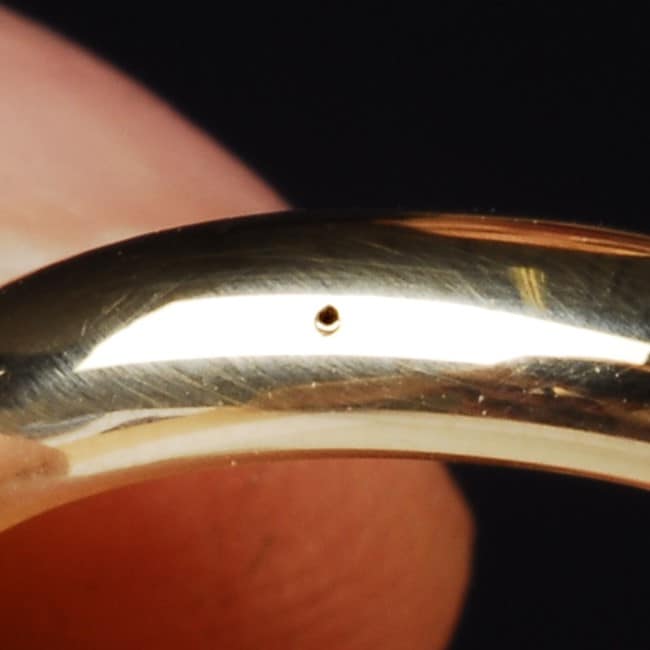
Pores occur during casting or due to material defects and are one of the most common quality defects in jewelry production and repair. This tutorial shows how pores can be specifically welded with the PUK – using different methods depending on the size of the pore and under the important prerequisite of a clean, dirt-free welding area for a permanent and invisible result.
1. Preparation
Depending on the size of the pore, various methods can be used to remove it.
An important prerequisite is that the weld or pore is clean.
No dirt such as polishing agent or investment material must be embedded in it!
2. Use a fresh electrode
Small, pinprick-shaped pores can often be closed quickly and easily. Use a pointed electrode and a low welding power.
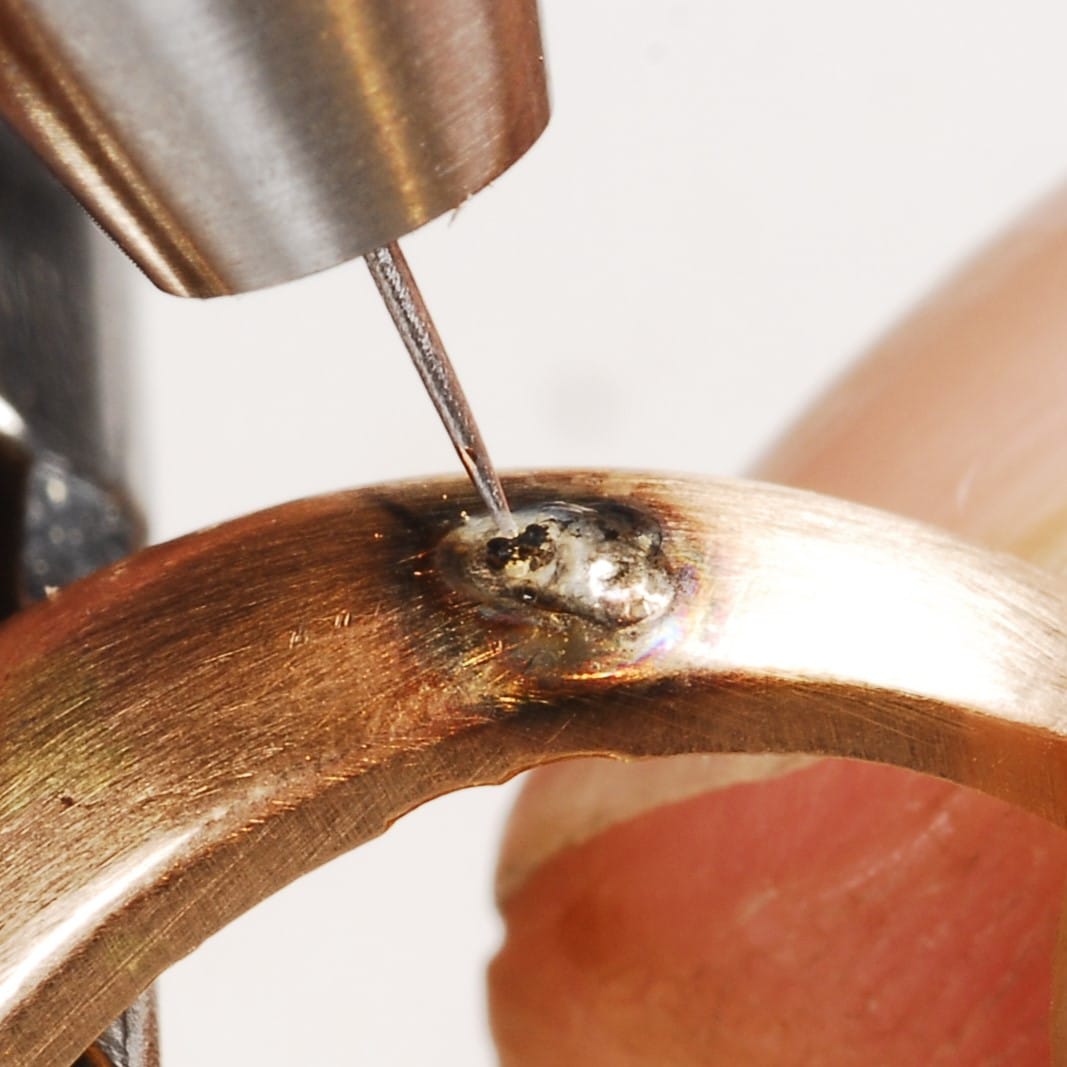
Hold the handpiece perpendicular to the workpiece surface and place the electrode
precisely in the pore.

3. Soldered joints
Be careful with pores in solder joints! Solder can vaporize due to the lower melting temperature and thus tear a larger hole. It is therefore better to work with a lower welding power and a short pulse duration.
4. Reaming for larger pores
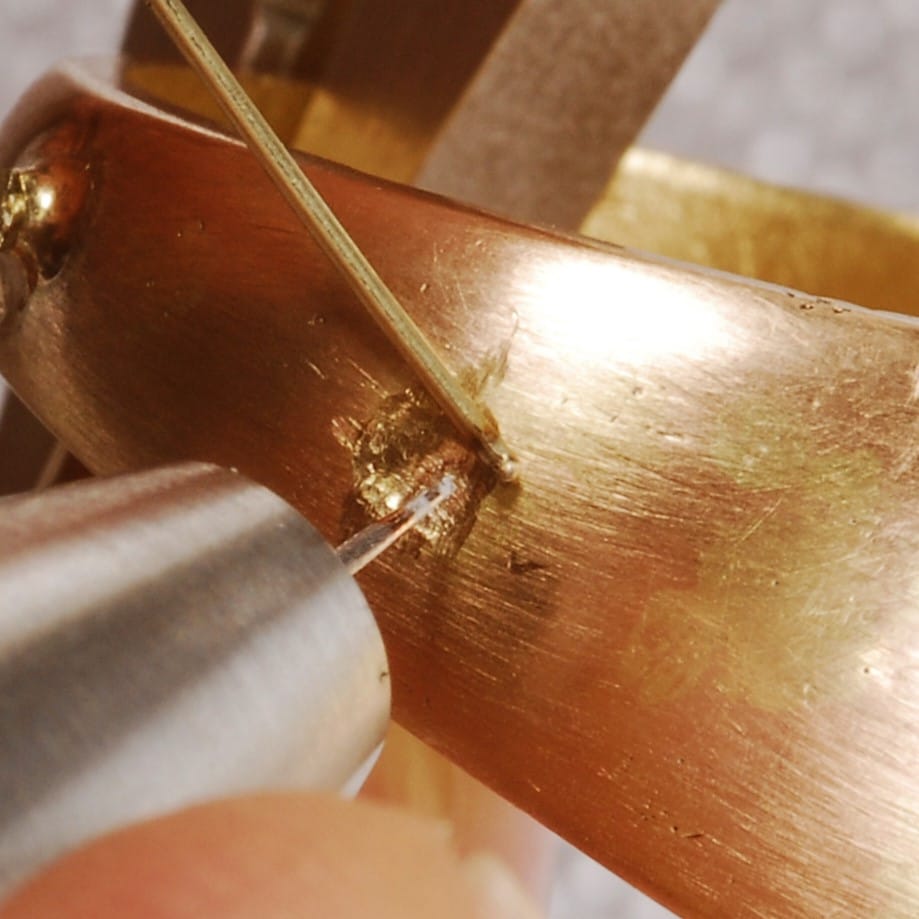
Larger pores that cannot be closed in the manner described above should be drilled out and a pin inserted. Lightly chamfer the edge of the hole with a scraper or milling cutter and shorten the pin so that it protrudes about 0.5 mm from the hole.
Then melt the edge of the pen into the joint all around.

5. Use a riveting wheel / cutter
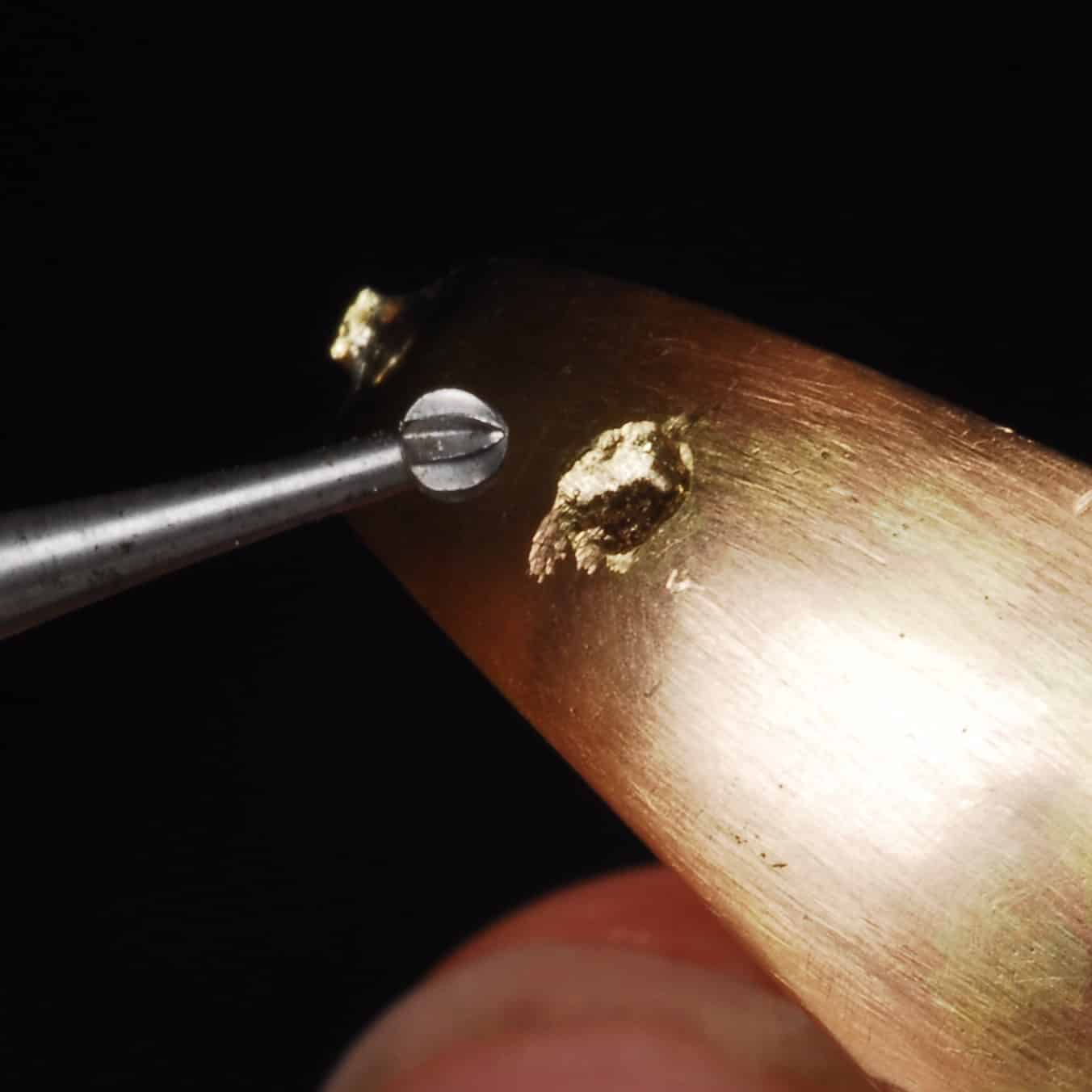
To improve the homogeneity of the freshly melted metal, process it with a riveting wheel, for example, or forge it lightly. Sometimes it is advisable to cut a recess with a ball cutter in order to weld in a ball. Place a welding spot vertically on the end of a wire to melt a ball. This should be slightly smaller than the milled recess.
6. Use welding wire
For larger porous areas, it is recommended to remove the entire upper metal layer with a milling cutter and fill the area with welding wire (see workshop 2.1 and 2.2). If the porosity is too deep to be milled out completely, you should apply a few spot welds without adding metal before filling. The porous area is compacted by this melting.
7 Correct welding
Always hold the electrode tip in such a way that the electrode moves across the indentation during welding. You pull the supplied welding wire in the direction of the indentation. The molten metal always flows together where the electrode is positioned! If the electrode has a flat angle of attack, the metal also flows from the point of contact in the direction of the electrode movement. Deep and steep pores can be made shallower and wider with a welding spot at the deepest point (possibly with a longer impulse) in order to fill them up better.
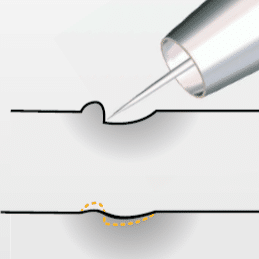
8. Shrink hole
Blowholes that are larger under the surface than can be seen from the outside are particularly annoying. The thin edge around the opening melts away and the hole becomes larger instead of smaller during welding.
In this case, it is advisable to mill out the cavity or to widen it slightly with several individual spot welds and then fill it with metal afterwards.
