


Hermetic sealing with micro-TIG welding
Hermetic closures, gas and liquid-tight seals for capsules, sensor housings and electronic components, require three properties: Tightness under pressure, minimal heat input to the capsule contents, and reproducible seam quality. Micro impulse welding with the Lampert Micro Arc Welder fulfills all three for labs, research, small series sensor production and medical technology.
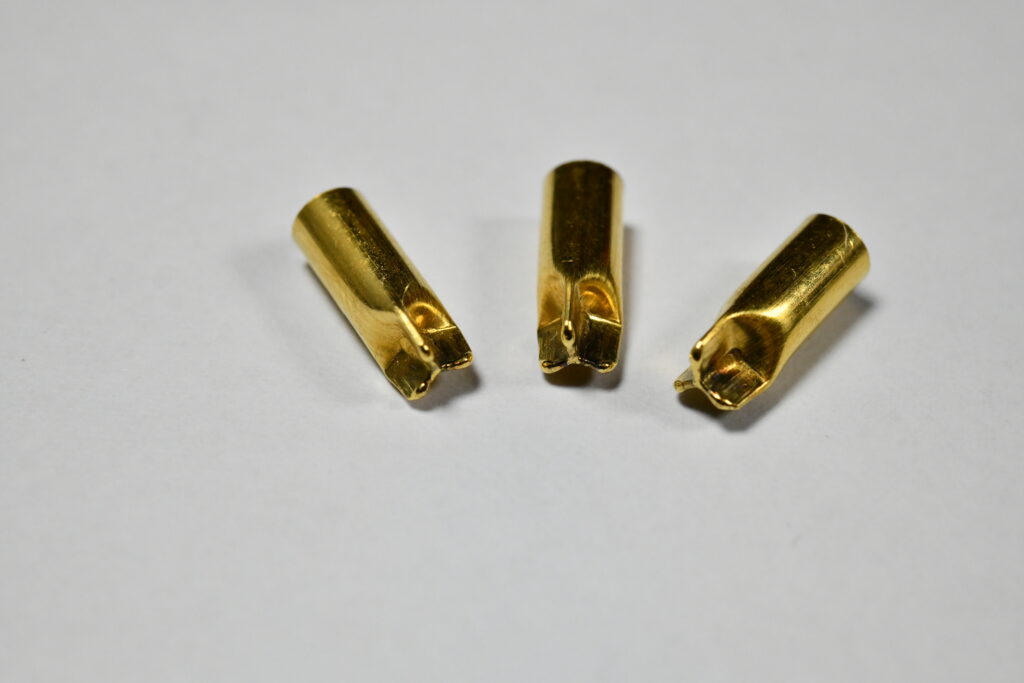
Why hermetic sealing is a process problem
Hermetically sealing a capsule, a sensor body or an electronics housing is rarely a question of the seam alone. The actual boundary condition is almost always what happens to the contents – radioactive seeds, lithium electrolyte, biological samples, air-sensitive catalysts, pre-loaded sensor electronics, calibrated pressure transducer filling. Heat travels. Vibration migrates. Contamination migrates.
This shifts the technical question from “can this seam be made gas-tight?” to “can this seam be made gas-tight without disturbing the contents?”
Three properties are crucial for this, in that order:
- Seam tightness below the application-specific leak rate. Typical hermetic specifications are between 10-⁶ and 10-⁹ mbar-l/s helium leak rate.
- Minimal heat input to the contents. The capsule wall receives the heat; the contents must not see it. The pulse duration in the millisecond range is the lever.
- Reproducibility across batches. Pre-installed welding curves, documented parameters and controlled workpiece pick-up beat operator experience alone.
Micro Impulse Welding with the Lampert Micro Arc Welder (MAW) addresses all three systematically.
Typical applications for Hermetic Sealing
Lab and scientific encapsulation:
- Brachytherapy capsules. Welding radioactive seeds in thin stainless steel or titanium capsules without thermally affecting the contents.
- High-pressure capsules. Platinum and Pt-Rh capsules for diamond stamp cell experiments, high-pressure experimental petrology.
- Glove box encapsulation. Seal air- or moisture-sensitive samples in an inert gas atmosphere.
- Reference and standard capsules for isotopic, neutron activation and trace element analysis.
Industrial sensors and electronics:
- Pressure sensor closure. IP67/IP68 stainless steel sensor housing hermetically sealed.
- Acceleration sensor and gyroscope capsules. Airtight and vacuum-tight sensor designs for aviation, automotive and measurement technology.
- Finish glass-to-metal feedthroughs. Final hermetic body closure on the sensor.
- Hermetic electronic enclosures for high-reliability applications (aerospace, subsea, defense, medical).
Medical technology:
- Implantable sensors and stimulators. Hermetically seal titanium and stainless steel housings without thermally damaging the internal electronics.
- Drug delivery capsules. Hermetically sealed active ingredient reservoirs.
- Encapsulation of sensitive electronics against body fluids in active implants.
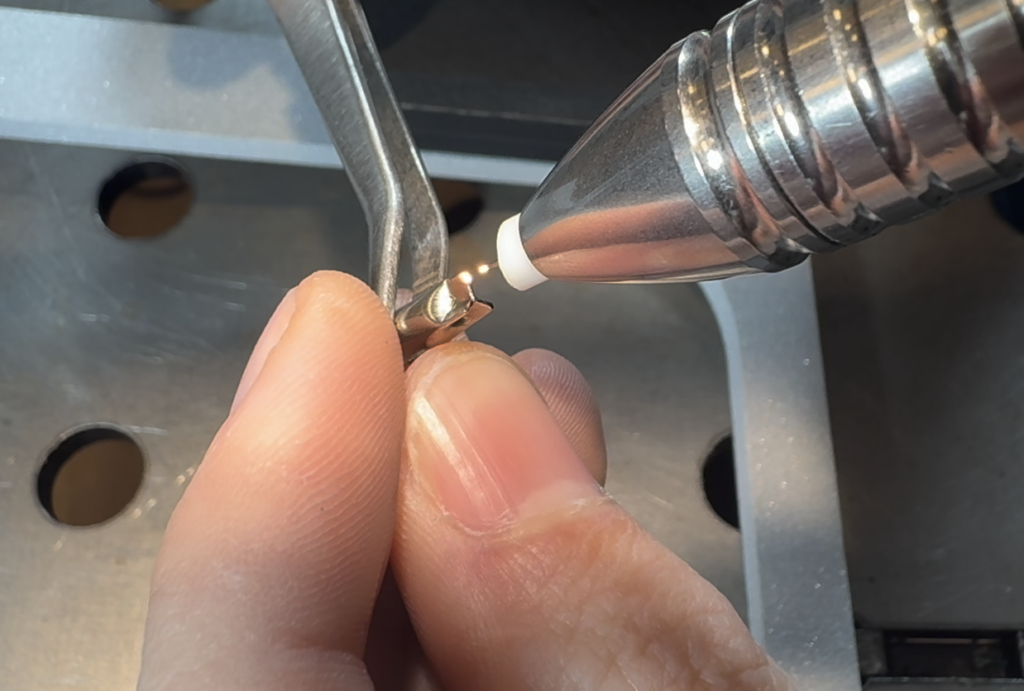
Materials for Hermetic Sealing
The following materials are established for hermetic seal welds with the MAW:
| Material | Typical use | Remark |
|---|---|---|
| Stainless steel 1.4404 / 316L | Sensor and pressure transducer housing, brachytherapy capsules | Very good weldability, biocompatible |
| Stainless steel 1.4307 / 304L | General lab encapsulation, food grade applications | Very good weldability |
| Titanium grade 2 / grade 5 | Implantable housings, corrosion-critical rennet capsules | Very good weldability, biocompatible |
| Platinum / Pt-Rh alloys | High-pressure capsules, diamond stamping cells | Very good weldability, thin wall thicknesses |
| Kovar (FeNiCo) | Glass-to-metal feedthroughs, electronics hermetics | Established for hermetic connections |
| Nickel-based (Inconel, Hastelloy) | High-temperature sensor housing | Very good weldability |
| Tantalum | Corrosion-critical encapsulation | Conditional, test welding recommended |
| Niobium / Zirconium | Lab special applications | Conditional, test welding recommended |
Why micro-TIG welding for hermetic closures
- Minimal heat input to the capsule contents. Pulse durations of 0.1 to 34 milliseconds keep the inside of the capsule practically at ambient temperature, even during seal welding. For brachytherapy seeds, biological samples, air-sensitive substances and pre-assembled sensor electronics, this is the difference between a usable component and a damaged one.
- Suitable for helium leakage. With proper preparation, the seam quality reproducibly achieves typical industrial hermetic specifications.
- Reproducibility thanks to pre-installed welding curves. The MAW comes with twelve material programs (stainless steel, titanium, nickel-based, platinum, copper, aluminum with dedicated aluminum mode, others). Parameters documented, processes repeatable.
- Glove-box compatible. With appropriate preparation, the MAW runs in inert gas atmospheres.
- Pure metallurgical connection. No flux, no soldering limit, no contamination paths. Important for lab applications with isotopic or chemical analysis.
- Cost and installation space advantage over laser for small series. Comparable closure quality at a fraction of the laser system investment, mobile table design. Laser remains the more economical choice for large series.
Comparison with alternative hermetic sealing processes
| Process | Strength | Weakness | Best suitability |
|---|---|---|---|
| Micro-TIG welding (Lampert MAW) | Single parts and small series, mobile, table-top design with microscope, wide range of materials, low investment | Not designed for mass production in the millions | Lab, research, small series of sensors, medical technology implants |
| Laser welding | High precision, automatable, large-scale production | High investment, stationary, large installation space | Large-volume series with defined geometry |
| Electron beam welding | Deep, narrow seam in a vacuum; very small heat-affected zone | Very expensive, vacuum chamber mandatory | High-quality hermetics in aviation |
| Glass-to-metal bushing (soldered) | Standard for electrical feedthroughs | Component, not body closure | Electrical cable bushings |
| Resistance path welding | Tab welding, large series | Only for defined geometries | Lithium cells, can closures |
| Ultrasonic welding | Fast, no heat input | Material-limited (polymer) | Polymer hermetics |
Rule of thumb: individual lab parts, research capsules, small series of sensors or medical technology implant housings → MAW. Mass production in the millions → laser or resistance path welding.
Practical recommendations
Preparation
- Thoroughly pre-clean the workpiece. Ultrasound is standard. Contamination causes pores to form in the seam.
- Finish the component in advance. Trimming, labeling, surface treatment before welding.
- Contents inserted before closure. Sequence: Insert contents → Close capsule.
Welding parameters
- Low energy plus sharp tungsten electrode for thin capsule walls. Practical start: 15-25 % energy, 0.5-1.5 ms pulse duration.
- Inert gas: Argon ≥ 99.9 % (Argon 4.6); optimum flow rate approx. 2 l/min with automatic upstream and downstream flow.
- For very heat-sensitive contents, additional thermal masking (Lampert item no. 100 355) or heat sink absorption.
Validation
- Helium leak test is possible after welding; the achievable leak rate depends on geometry and preparation.
- Visual inspection under a microscope. Clean, oxide-free seam without pores.
- Cross-section for initial samples. Document penetration depth and seam quality.
Device recommendation: the Lampert Micro Arc Welder
| Specification | Value |
|---|---|
| Peak current (TIG) | 5-1.200 A |
| Pulse duration | 0.1-34 ms |
| Minimum workpiece thickness | 0.1 mm |
| Spot weld diameter | 0.2-4.0 mm; >1 mm penetration with 1.3 mm electrode |
| Material programs (pre-installed) | 12 (universal, gold, silver, platinum, palladium, bronze, stainless steel, titanium, aluminum, tin, brass, copper) |
| Aluminum mode | Dedicated, optimized |
| Industry 4.0 interface | Modbus TCP/IP via LAN (21 documented registers) |
| Patented welding process control | Yes (real-time fault detection) |
| Inert gas | Argon ≥ 99.9 %; approx. 2 l/min |
| Display | High-resolution, 768 × 576 pixels |
| Weight | 10.9 kg |
| EU certification | EN 60974-6, EN 61000-6-2/-6-4, RoHS 2011/65/EU; UKCA-compliant |
| Guarantee | 3 years, manufactured and serviced in Germany |
| Investment (complete entry) | from approx. 7,000 EUR net |
| Training | One-day workshop in Werneck (own workpieces welcome) |
Full product specification: Lampert Micro Arc Welder product page.
Frequently asked questions about Hermetic Sealing
Yes, the encapsulation of brachytherapy seeds is an established application. The pulse duration in the millisecond range seals the capsule without thermally affecting the radioactive contents. Application-specific radiation protection requirements must be observed by the user.
Yes, depending on the geometry and target leakage rate. With proper preparation, typical industrial hermetic specifications achieve reliable values. For high vacuum applications (leak rate < 10-⁹ mbar-l/s), validate test samples in advance.
Yes, with appropriate preparation. The MAW runs in inert gas atmospheres, which is important for encapsulation that is sensitive to air or moisture.
Laser is more economical for millions of large series (lithium cells, standard sensor packaging). The MAW is superior for individual lab parts, research capsules and small sensor series. Lower investment, mobile design, wider range of materials and a dedicated aluminum mode.
Yes, platinum and platinum-rhodium alloys can be sealed very well with micro-TIG welding. Suitable for diamond stamp cell experiments, high-pressure experimental petrology and similar lab applications.
Argon ≥ 99.9 % (argon 4.6), optimum flow rate approx. 2 l/min with automatic upstream and downstream flow directly at the device.
Electron beam welding produces deeper, narrower seams in a vacuum chamber and is preferred for the highest aerospace hermetics, but costs several times as much as a complete system. Industry estimates put the machines at around EUR 400,000, plus the vacuum chamber infrastructure. For most lab and sensor applications without a vacuum chamber, MAW delivers functionally equivalent hermetics at a fraction of the investment.
The Lampert application team at [email protected]. Free sample welding with written welding report is possible, particularly recommended for hermetic sealing inquiries because the application specifications vary greatly.
Conclusion: when micro-TIG welding is the right choice for Hermetic Sealing
For lab capsules, research encapsulation, small sensor series and medical technology implant housings, the Lampert Micro Arc Welder delivers the three properties that matter: pressure-tight seams in the typical industrial hermetic range, pulse durations short enough to protect the capsule contents and twelve pre-installed material programs for reproducible results across batches. The investment threshold of around EUR 7,000 for a complete table-top workstation is an order of magnitude lower than comparable laser systems. This is crucial when the production volume is in the tens to thousands rather than millions.
For millions of large series with defined geometry, automotive sensor packaging, lithium cell sealing, laser or resistance path welding remain the more economical processes. The two approaches complement each other: a typical workflow uses micro-TIG welding for development, prototype validation and small series production and only switches to laser when the annual volume justifies the laser investment.
For test welds and application-specific advice, the Lampert application team is happy to receive inquiries at [email protected]. A written welding report is enclosed with every test weld.