


Micro-pulse TIG welding
in orthodontics and dental technology
In contrast to soldering with an open flame or resistance soldering (both with dental solder), where a small gap between the components is not a problem or is even useful, the aim when welding is generally to prepare the components to be joined without a gap, regardless of the welding technique used – whether with a PUK D6.1 micro-pulse welding unit from Lampert or with a laser.
If the gap dimensions of the components to be welded are too large, welding will quickly become difficult. It can therefore be helpful to build up components such as the separating gap of a cut bridge with welding wire until at least one contact point is available again. The same applies to the construction of combined implant bars or individual (implant) crowns to be splinted.
To eliminate gaps due to poor fit, orthodontic components such as the base of a Herbst hinge or brackets can be ground to match the shape of the respective substructure or round wires can be ground flat in advance for welding.
This issue should generally also be kept in mind when bending wires, especially for orthodontic appliances where very thin materials such as bands with a material thickness of well under 0.2 mm need to be stably connected to thicker wires of over 1 mm.
Otherwise, no connection can be achieved, or it is very difficult and time-consuming to achieve by adding welding wire.
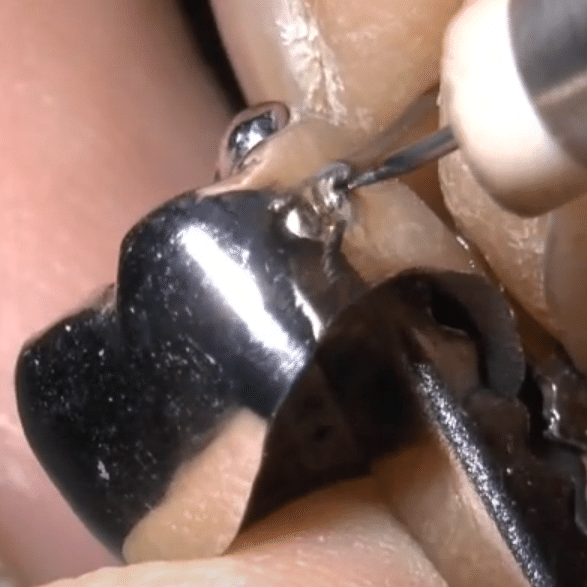
In certain cases, it makes sense to strategically attach stabilizing elements before welding a connection, e.g. in the case of a separated bridge or a repair of a cast partial. This can be a sprue, an old bridge, test objects or even a stored faulty casting, if possible made from the same alloy as the workpiece to be welded. Once the joint or build-up welding has been completed, these structures are cut off again and trimmed during the rest of the finishing process.
Denn: Schweißen an Zahnersatz oder an filigranen kieferorthopädischen Konstruktionen birgt generell das Risiko von Verzügen, z. B. an einem filigranen Sublingualbügel, und die eingesetzte Energie sollte stets wohl dosiert eingesetzt werden!
The preparation for a welded joint therefore requires significantly greater precision than for a classic soldered joint. On the other hand, there is no need to produce a solder model and, if necessary, remove and reattach acrylic parts.
As with all other dental applications , welding should only be started on clean and degreased surfaces. Acetone or commercially available brake cleaner are very suitable for preparatory cleaning.
Prior sandblasting of highly polished surfaces, as is usual in certain cases with laser welding, is not necessary for TIG welding with Lampert devices. The surface finish of the workpieces has no influence on the quality and the welding process.
The condition of the tungsten electrode tip is even more important for orthodontic applications than for welding in traditional dental technology, and it may need to be changed more often than for other applications (as it is ground at both ends, it can be easily turned in the handpiece).
It is always advisable to start a new job or a new work section with a freshly sharpened electrode tip, especially in angular welding situations, in order to be able to reach the desired position precisely – the electrode always welds at the points where it touches the workpieces directly.
The welded joints should always be finished as smooth as possible afterwards, but only as strong as absolutely necessary in order to avoid unnecessary weakening of the weld seam.
In conclusion, the greatest advantage of welding in dental technology and orthodontics over soldering is that stable welded joints can be produced without the use of solder.
This means greater safety for patients thanks to more stable connections with maximum biocompatibility.
Note: The examples shown only illustrate the various appliances in terms of their technical welding implementation and do not make any further technical claims with regard to medical aspects.
Individual, technical treatment considerations are of course reserved for medical specialists.
