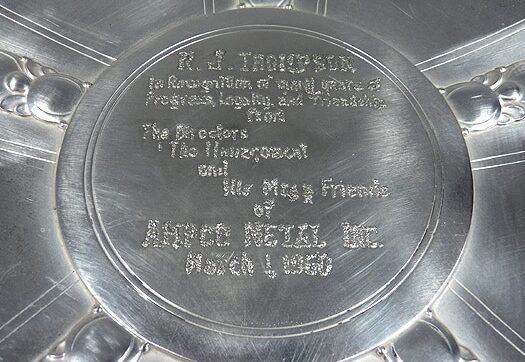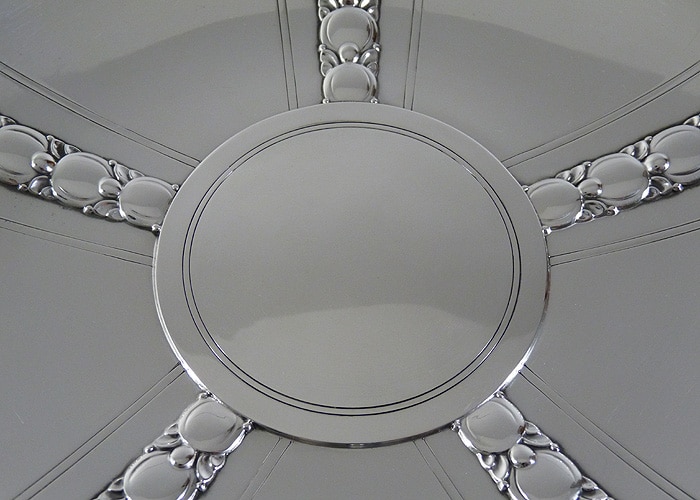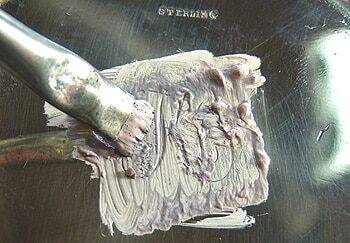
Removal of engravings
Welding silver is difficult due to its physical properties, regardless of the welding equipment used. The material’s high thermal conductivity in particular causes problems, as the welding energy is dissipated quickly and small welding spots are created with little depth effect. With PUK welding technology, it is possible to work with welding rods of the same alloy in many situations.
3. Ergonomic sitting position
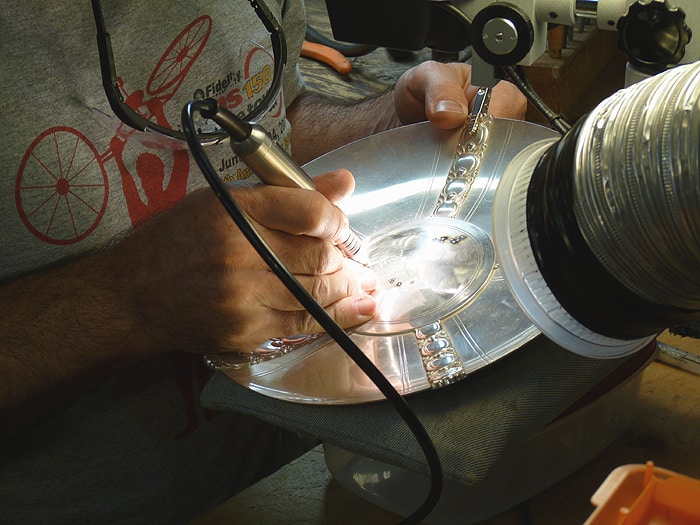
Work like this can take several hours. Therefore, try to adopt as ergonomic a working position as possible. Large workpieces in particular also require a good range of movement. In exceptional cases, the handpiece can therefore also be guided directly in the hand (but please never work without eye protection!)
4. Application welding wire
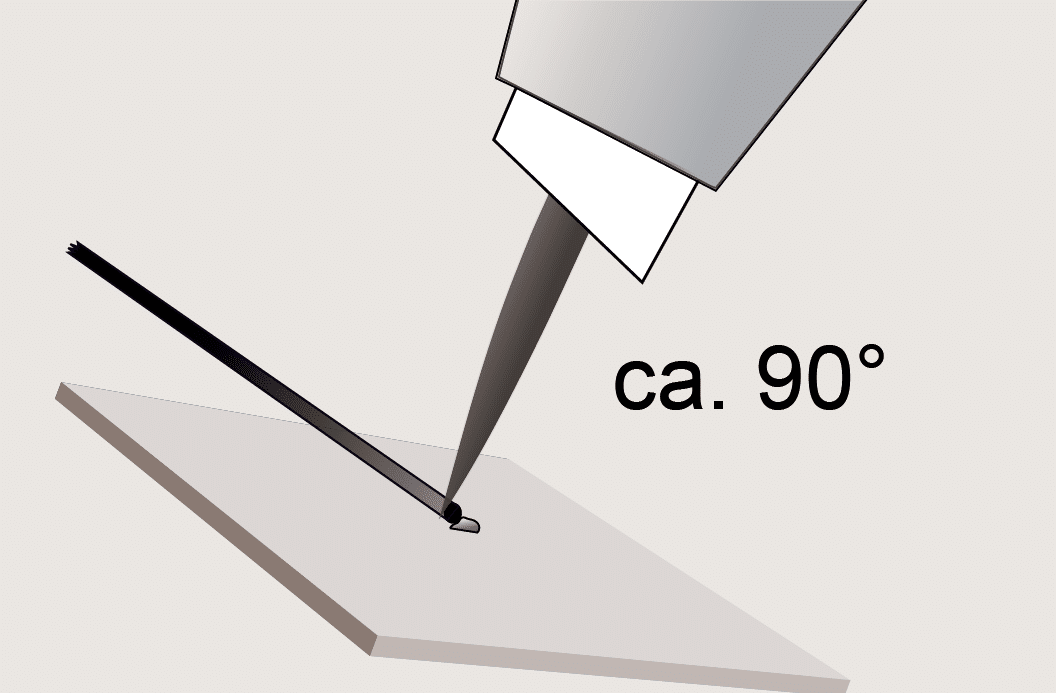
As silver is pushed rather than pulled by the arc, the electrode should be placed at an approx. 90° angle next to the wire or slightly overlapping during the welding process.
The welding wire (Ø 0.20 – 0.40 mm) is now welded to the surface drop by drop.
For this work, the parameters for silver, geometry application of welding wire ,
3 – 5 ms pulse duration and a welding power of 22 – 55 % should be used.
6.1 Compacting
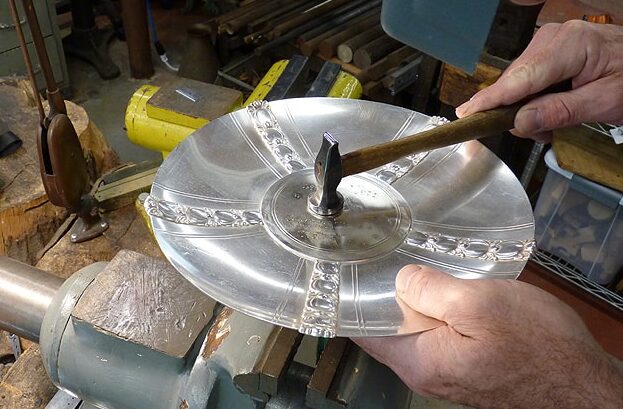
For large workpieces with flat surfaces, it is advisable to slightly level the applied material on the
anvil. This saves time when sanding and closes occasional pores.
Filling engravings on large surfaces may require subsequent soft annealing. The reason for this is that the filled material may have a different degree of reflection than the rest of the surface. This could otherwise result in a kind of “ghost” of the original engraving remaining visible.